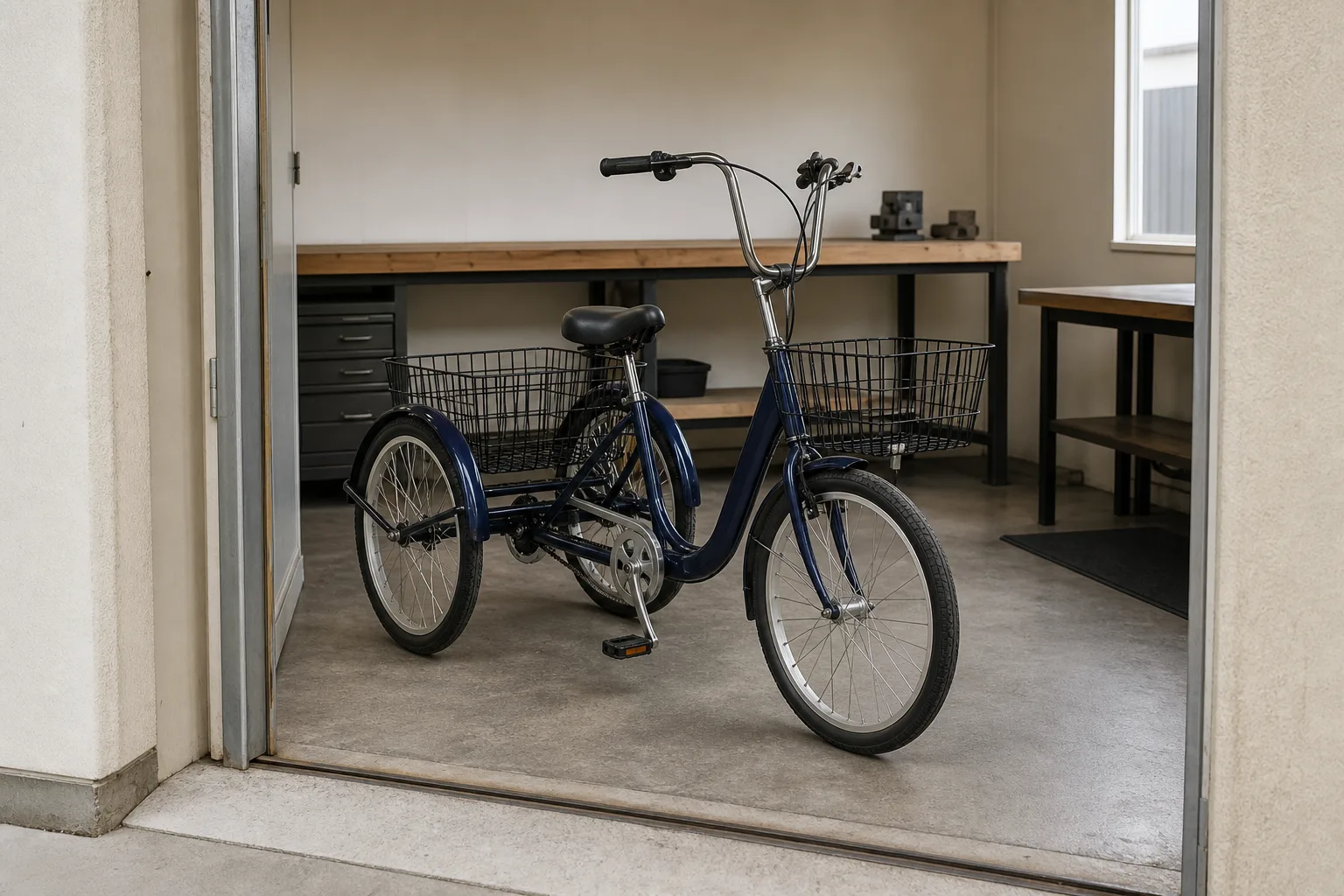
A two-wheeled bike forgives almost every storage decision you make, because it can be turned on its side, hung from a hook, wheeled through a gap barely wider than its handlebars, and carried up a flight of stairs by one determined person. An adult trike forgives none of that. It is a rigid rectangle roughly two and a half to three feet across, it does not lean, it does not fold unless it was designed to, and it weighs enough that dragging it sideways over a threshold stops being a solution by the second week. The checks below happen before the order, not after.
1. Track width, measured against the narrowest point on the route
Track width is the distance between the outer faces of the two rear tires on a delta, or the two front tires on a tadpole, and it is the single number that decides whether the machine can get to where it sleeps. Measure the tightest constriction on the whole path, which is rarely the garage door itself: it is the gate posts, the side passage between house and fence, the turn at the bottom of a ramp, or the water heater that eats eight inches of a garage corner. Add two inches of clearance on each side for hands and error. Published track figures sometimes exclude fender bulge, so confirm with the seller.
2. What arrives in the box, and what is left for you
Most trikes ship partially assembled, and the parts left loose are usually the ones that matter for alignment: the handlebars and stem, the front wheel, the seat post, the fenders, the basket, and one or both pedals. On many delta models the rear axle assembly is bolted in place but not tensioned or trued, and the rear brake cable arrives connected but slack. Budget for a shop to finish it. A careful buyer photographs the box on arrival, checks the axle for shipping damage before anything else, and treats the included wrench as a tool for getting home, not for final torque.
3. Racks, hitches, and the honest answer about vans
Standard hanging and platform bike racks do not fit adult trikes, because there is no single frame triangle to clamp and no way to balance a three-point footprint on two rails. A few manufacturers make wide platform carriers rated for trikes, and they require a two-inch hitch receiver and a tongue weight allowance you should read off the vehicle's own placard rather than guess. The practical alternative is a van or a pickup with a ramp, and a minivan with the second row removed will usually take a delta trike upright with the front wheel turned. Measure the cargo opening, not the cargo volume.
4. Finding a shop that will work on the axle
Many bike shops will service a trike's brakes, tires, and drivetrain without hesitation, then decline anything involving the rear axle, because a delta axle is a solid or differential-driven shaft with bearings and hardware that share nothing with a standard bicycle hub. Call ahead and ask the specific question: has anyone in the shop pulled a trike axle before. Mobility dealers, recumbent specialists, and shops that stock adaptive cycles are the reliable answers. The Consumer Product Safety Commission is the federal body responsible for bicycle safety requirements, and a shop that follows those requirements closely will usually tell you plainly what it does and does not service.
5. The parking spot, decided in advance
Decide where the trike lives before it arrives, and check that spot for three things: a level floor, because a trike parked on a slope will roll unless the parking brake is set every time; a wall or corner where its width does not block a car door; and access to an outlet within cord reach if the machine is powered, since carrying a battery indoors each night is a chore people abandon by spring. A folding model solves a narrow gate but folds no faster than the person doing it. Measure the spot, then measure the trike, then confirm the two agree.
None of these checks take long, and each one is far cheaper before purchase than after. The buyers who end up happy are the ones who walked the route with a tape measure, called two shops, and knew the hitch rating before the delivery truck turned into the street.