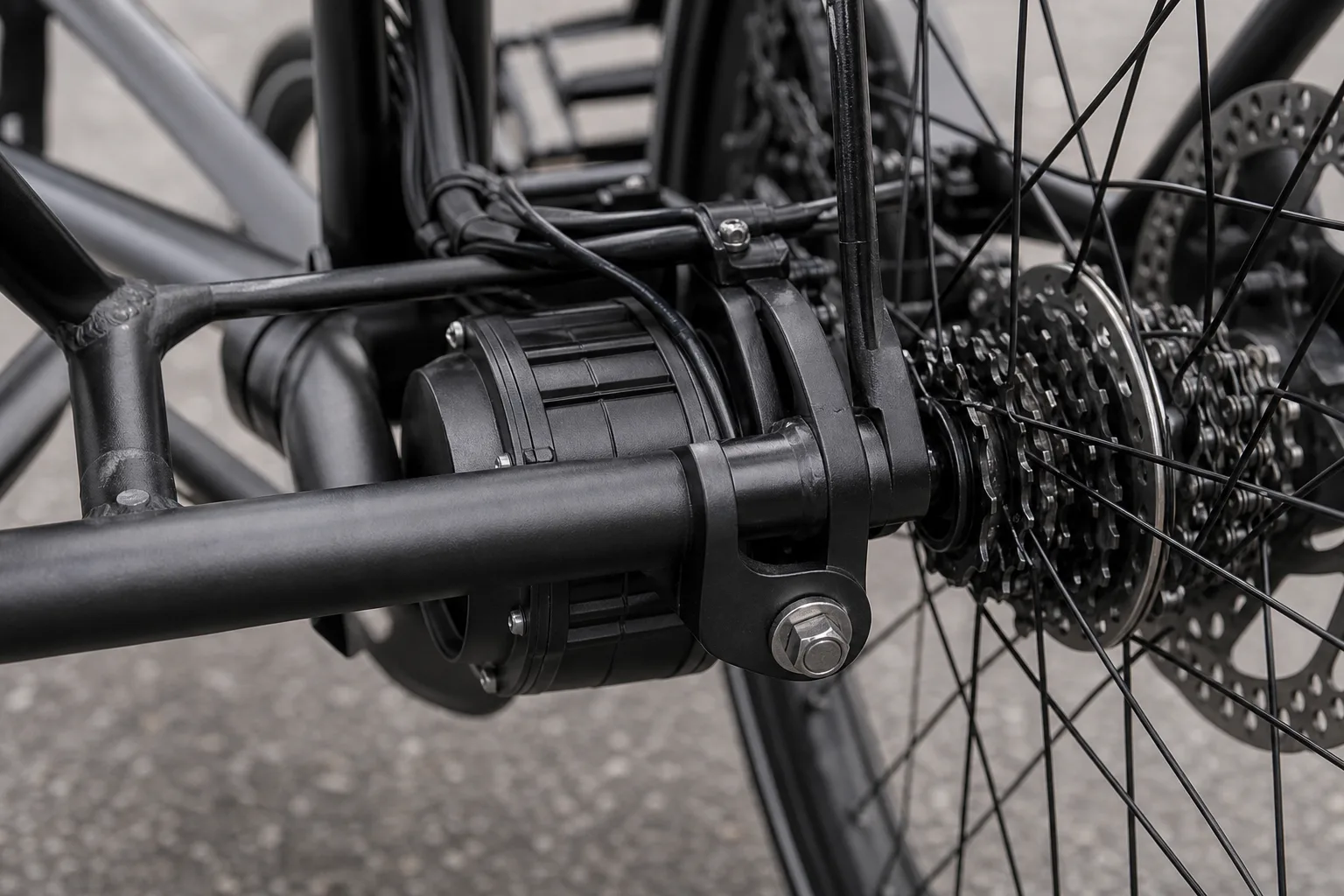
A motor changes a three-wheeler in two directions at once. It removes the hill, the headwind, and the twenty pounds of groceries from your legs, and it adds somewhere between fifteen and forty pounds to a machine that already weighs more than a bicycle and does not lean when you steer it. Both effects are real, and they arrive together. The careful buyer separates them before signing anything, because the parts of the trike that carry the new weight, the brakes, the wheels, and the rear axle assembly, are the parts that get specified last and questioned least.
Hub or mid-drive, and what the rear axle has to do about it
Most adult trikes drive both rear wheels or one of them through a solid axle or a differential, and that arrangement decides which motor makes sense. A rear hub motor on a delta trike usually drives one wheel only, which is simple, quiet, and independent of the chain, but it applies power to one side of a machine that already tracks a little unevenly on camber. A mid-drive sends torque through the existing chain into whatever the axle already does, so a differential keeps behaving like a differential and a solid axle keeps its predictable push. The trade is chain and sprocket wear, which climbs noticeably once a motor is contributing.
On a tadpole trike, where the single wheel is at the back and drives alone, the question simplifies. A hub there behaves like a hub on any bicycle, and a mid-drive there multiplies through the gears, which matters if your route has real climbing. Ask the seller which wheel the power actually reaches, and ask what happens on a wet, off-camber driveway when it does.
Battery capacity against the range you will actually get
Capacity is printed in watt-hours, and the honest way to read it is as a ceiling nobody reaches. The number on the label comes from a test rider on flat pavement in low assist with no cargo, and your trip has a full basket, a stop sign every block, a headwind on the way back, and the rolling resistance of three tires instead of two. Frontal area and weight both punish a trike more than a bicycle, and cold weather trims usable capacity further. A reasonable planning assumption is that a loaded errand run in moderate assist consumes power at roughly twice the rate the brochure implies.
That means the useful question is not how far the pack goes but how far your longest regular trip is, doubled, with a margin. If the answer sits well inside the pack's rated range, the trike will feel effortless for years. If it sits at the edge, look at the next capacity up, or at whether the frame accepts a second pack, because pedaling a heavy powered trike home on a dead battery is the one experience owners describe in the most detail.
Brakes sized for the mass, not for the frame
A powered trike carrying a rider and a load can approach twice the moving mass of an unassisted bicycle, and it descends at speeds the unassisted version rarely reached. Rim brakes and small mechanical discs, adequate on a pedal-only trike, run out of heat capacity on a long grade. What to check: rotor diameter front and rear, whether the calipers are hydraulic, and whether both front wheels on a tadpole get equal, well-adjusted braking, since uneven front braking on three wheels produces a pull toward the stronger side. Larger rotors and hydraulic actuation are the ordinary fix, and many powered models now come with them as standard.
The pack you will buy again
Lithium cells lose capacity with cycles and with time, and a pack that starts comfortably long begins feeling short somewhere in its third to fifth year of regular use. Replacement is the largest single running cost of a powered trike, typically a meaningful fraction of what the whole machine cost, and it is entirely predictable, which makes it easy to plan for. Two things protect the investment: buying a model whose pack is a documented, orderable part rather than a proprietary shape, and charging to a partial state rather than full when the trike will sit for weeks. The Consumer Product Safety Commission oversees safety standards for consumer lithium battery products, and buying a pack and charger from the original manufacturer or a listed equivalent is the straightforward way to stay inside that framework.
Weigh the trike as it will be ridden, loaded, and ask the seller what the brakes and the pack cost to replace. Sellers who answer both questions quickly tend to be selling the machines worth owning.