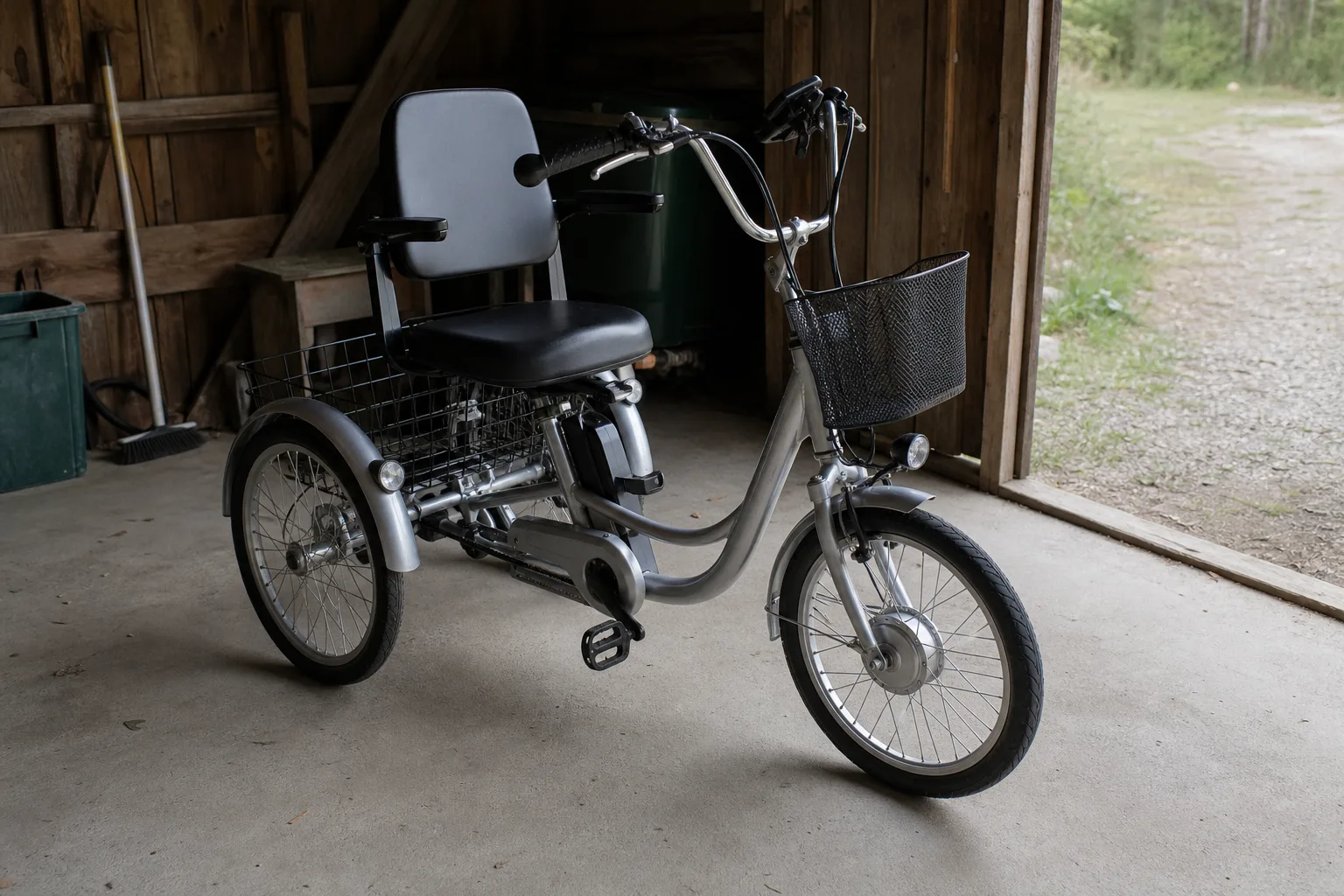
A rider who went through this decision compares delta and tadpole layouts, pedal-only and powered versions, and the running costs nobody mentions in the showroom. Nothing here is for sale.
The reason most people start looking at adult three-wheelers is narrow and specific: the bike is fine once it is moving, and the trouble is everything else. Stopping at a light with a bag of groceries on the rack. Getting a foot down on a driveway that slopes the wrong way. Restarting uphill. A third wheel removes that whole category of problem in one move, permanently, without any technique to learn or maintain. What it does not do is leave the rest of the machine unchanged, and the honest version of the decision is understanding exactly which parts of riding get harder in trade.
The standstill problem, solved outright
A two-wheeled bicycle is stable because it is moving, and the rider is constantly making small steering corrections to stay under the center of mass. Below walking pace those corrections stop working and the rider carries the load with legs and reflexes. Three wheels change the arithmetic completely. The machine stands up by itself at zero miles an hour, loaded, on a slight cross-slope, with nobody touching it. For a rider with a balance disorder, an inner-ear issue, a knee that will not take a sudden sideways load, or simply a lifetime of not wanting to fall, that single property is worth more than every other feature on the specification sheet combined.
It also changes what the bike can carry. A basket that would make a bicycle unmanageable at a curb is a non-event on a trike, and cargo that shifts while you ride is a nuisance rather than a hazard. That capability is why so many buyers arrive at three wheels through errands rather than through recreation, and it is the part of the machine that most reliably lives up to expectation.
Width is the cost you pay every single ride
Adult trikes typically run somewhere between thirty and thirty-six inches across the rear axle, and that number governs more of your daily experience than motor wattage ever will. A bike lane with a drain grate on one side and a curb on the other stops being a lane and becomes a slalom. Sidewalk cutouts, bollards at the entrance to a rail trail, the gap between a parked car and a construction barrel, and the door of a public restroom all become measurements rather than assumptions. Before buying, measure the narrowest point on your regular route, then measure your garage door and the path to it.
Width also has a storage cost that shows up as rearranged furniture, a hallway you can no longer walk two-abreast, or a shed that needs a second door. None of this is prohibitive. It is simply a set of decisions you make once, at the beginning, and live with afterward.
Weight, and what a motor does to it
Three wheels means an extra wheel, an extra tire, a rear axle assembly, and usually a heavier frame to hold the whole thing square. An unpowered adult trike commonly lands well north of a comparable bicycle, and a powered one adds a battery, a motor and a controller on top. That weight is invisible while you ride on flat ground and extremely visible everywhere else: lifting the rear end to clear a step, loading onto a hitch rack rated for the actual number, pushing the machine backward out of a tight parking spot, or getting it up a short steep pitch on a dead battery.
This is where a motor stops being a luxury and becomes a structural answer to a problem the frame created. A 3 wheel electric bike carries its own mass up the hill instead of asking your legs to, which for many riders is the difference between a trike that gets used and one that sits. The Consumer Product Safety Commission is responsible for the federal standards that cover bicycles and the low-speed electric bicycles sold alongside them, and reputable manufacturers build to that framework.
Cornering is a different skill, not a lost one
On a bicycle you lean, and the lean is automatic and unconscious. A trike frame does not lean, so the turn is taken flat, and the outside wheels carry load that has to go somewhere. Take a corner too fast and the inside rear wheel gets light and lifts. That is the single behavior that surprises new trike riders most, and it is entirely manageable once you know it exists: slow before the turn rather than during it, keep your weight low and toward the inside, and treat downhill corners with more caution than you ever needed on two wheels.
The layout matters here. Two wheels at the back with one in front is a delta; two wheels in front with one at the back is a tadpole, and the second geometry sits lower, corners flatter and behaves differently under braking. Neither is universally better, and the choice follows from where you ride and how you plan to get on and off.
What the rest of this site works through
Everything above opens a loop that a single article cannot close. Delta against tadpole in real turns, what a motor adds in capability and in pounds, where the machine sleeps and who repairs it when a proprietary hub goes quiet, tire and brake wear on a heavier vehicle, and the parts a local bike shop will and will not touch. Those are the pieces that decide whether a trike becomes the thing you ride four times a week.
The trade is clear enough to make deliberately. You give up narrowness, some lightness, and the free lean of two wheels. You get back the ability to stop anywhere, carry anything, and start again without thinking about it, which for a great many riders is the entire point.